

China Prefabricated Steel Buildings: Benefits, Costs, and Key Considerations
2026-11-02
Ask any contractor who’s managed a build in China, and they’ll tell you the same thing: the difference between profit and loss often comes down to speed and predictability. Prefabricated steel buildings have reshaped that equation—but the real story isn't just about fast assembly. It's about where the hidden costs hide, which design choices actually save money, and what local regulations demand before you break ground. At GETO, we've helped project owners navigate these trade-offs across dozens of Chinese provinces. In this guide, we'll walk you through the practical benefits, honest cost breakdowns, and key considerations that most generic supplier brochures leave out. If you're evaluating steel construction for your next project, the next ten minutes could save you from expensive surprises.
Why Prefabricated Steel Is Reshaping Construction in China
Cranes swing entire room modules onto high-rise cores while workers bolt steel frames together with the speed of assembling furniture. This isn't a futuristic demo—it's a typical Wednesday on a Chinese construction site. Prefabricated steel has moved from niche experiment to default choice for a simple reason: it solves the stubborn problems of labor shortages, waste, and erratic quality that have long plagued concrete-heavy building methods. When a developer in Chengdu can erect a 30-story office tower in under ten months, the old way of pouring floors slab by slab starts looking like a relic.
The shift is also about precision. Steel members arrive laser-cut to millimeter tolerance, with connection plates and bolt holes already punched. On site, there's no guesswork or rebar bending—just alignment, torqueing, and the occasional shim. This removes the human error that leads to cracked columns or misaligned walls. Meanwhile, the material itself offers a second life: after a building's service period, steel beams can be unbolted, re-rolled, or reassembled elsewhere. In a country pushing hard for circular-economy goals, that's not a niche benefit—it's a policy lever.
Yet the real reshuffling lies in how it changes project economics. Shorter construction cycles mean developers start earning rent or sales revenue months earlier, which often outweighs the higher upfront cost of steel. Factories in Hebei and Jiangsu now run robotic welding lines for standard frames, cutting per-unit costs as volumes climb. The ripple effect hits training programs, too: a new generation of workers is learning to read 3D models and operate torque wrenches rather than haul concrete. Prefabricated steel isn't just altering the skyline—it's quietly rewriting the job descriptions behind it.
What Actually Drives the Price of a Chinese Steel Building
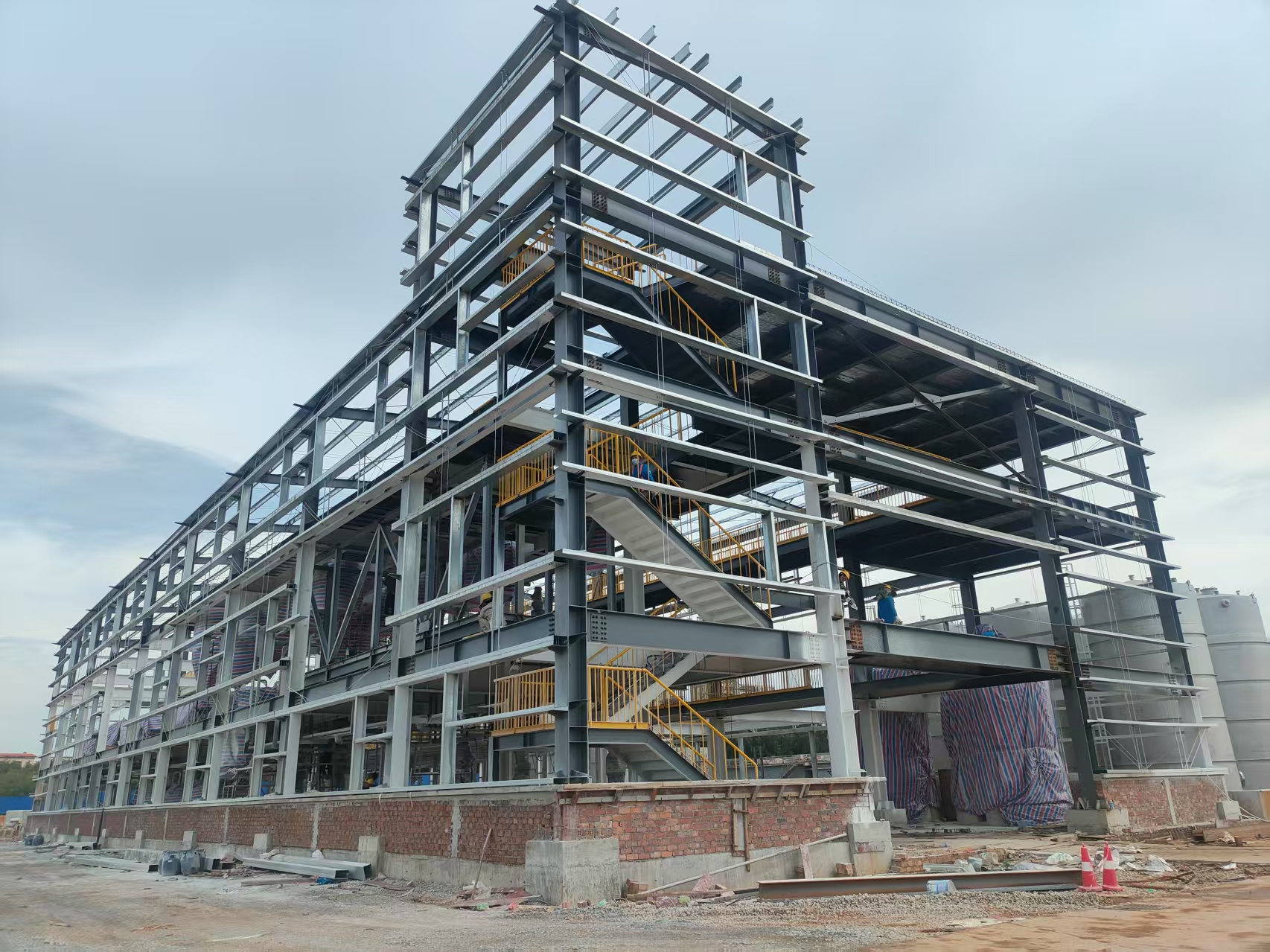
Steel pricing isn't just a commodity ticker. The grade, thickness, and coating requirements of your building's frame shift per-ton costs significantly. A standard warehouse with galvanized purlins and girts will run differently from a heavy industrial plant needing high-strength columns and blast-resistant cladding. Chinese mills often base quotes on exact specifications, so seemingly small changes in design snowball into a noticeably different final figure.
Fabrication labor in China remains lower than many Western markets, but that gap has narrowed. Skilled welders, CNC operators, and quality inspectors now command competitive wages in major manufacturing hubs like Shanghai or Tianjin. The level of pre-assembly and testing requested also influences the final invoice. A building that ships as bolt-together panels with pre-installed connections costs more in factory hours but saves field labor later, and that trade-off is rarely obvious up front.
Logistics and tariffs are the wildcard. The distance from the Chinese port to your site, container versus breakbulk shipping, and current ocean freight rates can eclipse the base steel cost. Plus, import duties or anti-dumping measures in your country may apply. Bulk purchasing multiple identical buildings lowers per-unit transport, but custom one-offs eat that advantage quickly, making location and order size just as important as the steel itself.
Hidden Trade-Offs You Should Know Before Ordering
That glossy product photo rarely shows the full story. A chair that looks sculptural might wobble on thick carpet; a lamp with a slim brass arm may cast a harsh pool instead of a warm glow. Before you tap “buy,” consider the materials that don’t photograph well—thin acrylic that scratches if you breathe on it, or a marble top that arrives with veins wildly different from the sample. These aren’t flaws in the traditional sense, but they’re the quiet reasons some pieces get returned more than others.
Shipping costs can also hide in plain sight. A mirror that seems reasonably priced becomes less so when you discover it ships freight-only, requiring a loading dock and a second pair of hands. Assembly instructions might be a single cryptic diagram, and suddenly your weekend is lost to an Allen key and a bag of mystery screws. None of this appears in the spec sheet, but it shapes how you’ll feel about the purchase a month later.
Then there’s the durability question nobody asks until it’s too late. A velvet sofa in a sunlit room fades faster than you’d expect, and a handwoven rug’s delicate fringe may not survive a robot vacuum. The trade-off isn’t between good and bad—it’s between what you see online and what you live with daily. Knowing the hidden costs of own, not just order, changes which pieces earn a permanent spot in your home.
From Factory Floor to Final Assembly: How the Process Really Works
The journey begins well before any components meet on the line. Raw materials are received at receiving docks where they are logged, inspected, and moved to staging areas. From there, precision machining centers cut, drill, and shape parts within tolerances measured in thousandths of an inch. Automated guided vehicles shuffle these pieces to sub-assembly stations, where workers or robotic arms attach smaller fittings, brackets, and connectors. This isn't a clean, linear flow: real factory floors hum with forklifts backing up, line-side carts being refilled, and quality checks interrupting the pace whenever a measurement drifts.
Once individual modules are built and passed inspection, they converge at final assembly. Here, the main frame or chassis enters a moving line, and each station adds a specific layer—wiring harnesses, hydraulic lines, electronic control units, cosmetic panels. The sequence matters less than the documentation: every bolt torque, every fluid fill, every software flash is recorded against the unit's serial number. If a station falls behind or a defect is caught, the line may pause or the unit gets pulled into a repair bay rather than continuing downstream. This constant feedback loop between the floor and the final line is what keeps a single bad part from becoming a whole batch of rework.
At the end of the line, the product isn't simply wheeled out the door. It undergoes a battery of end-of-line tests—leak checks, electrical diagnostics, functional movement simulations—designed to mimic the first hours of real use. Only after passing those does it receive its final labels, protective packaging, and a slot on the outbound logistics dock. The line may stop for a missing bolt or a lagging software update, and that stoppage is data. High-mix facilities, especially, rely on this rhythm of interruption and correction rather than a perfect, unbroken sprint. That's the reality behind the tidy flowcharts: progress happens through a series of controlled pauses, checks, and handoffs.
Design Freedom vs. Engineering Limits in Prefab Steel
Prefab steel walks a fine line between what architects dream up and what the material will actually allow. On one side, you have designers pushing for sweeping open spans, razor-thin profiles, and complex geometries that would make a conventional concrete pour blush. On the other, the steel itself imposes hard boundaries—bolt spacing, load paths, and the stubborn physics of thermal movement. The result is a conversation, not a monologue: every creative curve has to survive a reality check against the shop drawings.
What often gets lost is that these limits can be a design language in their own right. The modular grid that engineers insist on becomes a rhythm; the exposed connection plates turn into honest ornament. Rather than fighting the constraints, the best prefab steel projects lean into them, letting the joint patterns and standardized member sizes shape the aesthetic. It is less about compromise and more about discovering what the material wants to be.
The real skill lies in knowing which battles to pick. You can cantilever a mezzanine farther than most people think, but only if you accept a deeper beam or a slightly thicker flange. You can have that floating glass corner, but the steel frame behind it will need some diagonal bracing somewhere. Freedom without an understanding of the limits is just a pretty picture; limits without a push for freedom give you a warehouse. The sweet spot is where both sides think they won.
Avoiding the Usual Pitfalls When Sourcing from China
Most problems start before money changes hands, so dig into who you're actually dealing with. A slick website means almost nothing in this space. Ask for the factory's business license, check the registered address against the real location, and insist on a video tour or a third-party audit if the order size justifies it. If the person you're talking to can't provide clear answers about production lines, lead times, or raw material sourcing, you're likely speaking to a trading company posing as a manufacturer.
Vague specs are the quickest way to receive a container of useless inventory. Write down every detail: dimensions, tolerances, material grade, color codes, packaging, even the type of tape used on cartons. Approve a pre-production sample, lock in a golden sample, and don't let the factory deviate without written approval. For anything above a few thousand dollars, bring in a third-party inspection before the balance payment leaves your account.
Payment terms and intellectual property need more than a handshake. Avoid paying 100% upfront; a 30% deposit with the balance against a copy of the bill of lading is common, but for larger orders use a letter of credit or an escrow arrangement. If your product has unique designs, register your trademarks and patents in China before you share files, and have a bilingual contract that names the actual factory, not just a sales agent.
FAQ
Chinese manufacturers often operate large-scale production lines with tightly integrated supply chains, which allows them to offer high-quality steel components at lower unit costs. Many factories use automated welding and cutting equipment that reduces human error and shortens lead times. They also have extensive experience adapting designs to different national building codes, making them a practical option when budgets are tight or schedules are short.
The initial purchase price can be 20 to 40 percent lower than conventional on-site building, but you need to add ocean freight, inland transport, duties, and possible inspection fees. Labor costs for on-site assembly also vary by region. In remote locations, logistics can eat into the savings. A useful approach is to ask the supplier for an itemized quote that separates steel grades, coatings, connections, and packing, so you can compare it with a local bid line by line.
Steel has high strength and ductility, meaning it can absorb seismic energy through deformation without sudden collapse. Prefabricated steel frames usually rely on bolted or hybrid connections that are made in the factory under strict tolerance control, so they perform more predictably during ground movement. Many Chinese producers can also supply detailed joint calculations and test reports based on ISO or local seismic codes, adding confidence for buyers in active fault zones.
Start by confirming the factory holds relevant international certifications such as CE, AWS, or ISO 9001, and ask for photos or references from past export projects. Clearly define load requirements including wind, snow, and seismic parameters so the design is not based on minimum defaults. Discuss the coating system, such as galvanized plus polyester or PVDF, and insulation thickness because these affect service life and energy use. Finally, get a written agreement on packing, shipping marks, and on-site installation support to avoid disputes after delivery.
Standard industrial sheds or warehouses typically take four to eight weeks to produce, depending on complexity and queue. Special customizations like long-span trusses or heavy crane girders can push production beyond ten weeks. Ocean freight ranges from two to six weeks depending on destination, and customs clearance plus inland haulage adds another one to three weeks. A realistic lead time from order to site arrival is usually three to four months.
Yes, most medium to large factories have engineering teams that can develop detailed designs from the buyer's drawings or concepts. Beyond standard industrial looks, they can produce decorative facade panels, different roof slopes, mezzanine floors, or attached office blocks. As long as connection details and material standards are agreed upfront, the factory can usually adjust column spacing, eave height, and openings without a major cost increase. Non-standard shapes do require a longer design approval period.
Inspect the roof drainage system regularly and clear gutters and downpipes to prevent standing water from accelerating coating wear. Every two to three years, check bolted connections for looseness or rust and touch up any damaged areas with anti-corrosion paint. In coastal or high-humidity environments, choose wall panels with an aluminum-zinc substrate and PVDF topcoat, and use stainless steel fasteners during installation. If the interior stores corrosive materials, add extra ventilation and floor protection.
One frequent issue is differing assumptions about standard configuration, such as purlin thickness, bracing quantity, or insulation density. To prevent this, attach a detailed technical specification and bill of materials to the contract, and identify brands or equivalent standards. Another pitfall is skipping third-party inspection, so weld or coating defects are only discovered after arrival. Arrange for an independent agency to check steel grades, weld appearance, and coating thickness before shipment.
Conclusion
Prefabricated steel construction in China has quietly moved from a niche option to a practical default for warehouses, workshops, and even multi-story commercial spaces. The shift is not just about speed—though a well-organized factory can cut on-site assembly time dramatically—but also about consistent quality. Welders and cutters work under roof with jigs and automated lines, reducing the weather delays and skill shortages that plague traditional concrete pours. Cost, however, is rarely a single number. Steel grade, purlin spacing, insulation thickness, and even the distance from the port to your site all quietly move the final invoice. Buyers who hunt only for the lowest per-square-meter quote often miss basics like load calculations for local snow or wind, which can turn a cheap frame into an expensive retrofit.
Before you wire a deposit, dig into the trade-offs nobody prints on the sales sheet. Thinner galvanizing may save money now but invite rust near coastal salt; cheaper sandwich panels can buckle under summer sun if the foam density is too low. The process itself is fairly linear—shop drawings, cutting, welding, test assembly, then flat-packed shipping—but misunderstandings at the drawing stage multiply later as missing bolts or mismatched base plates. Design freedom exists, yet it bends to engineering reality: long clear spans demand heavier beams, and not every “custom” look survives container width limits. Smart sourcing means asking for a trial assembly report, checking third-party weld inspections, and locking down a penalty clause for late delivery. Chinese suppliers range from family workshops to ISO-certified plants, and the difference shows in the details—edge finishing, hole alignment, and how quickly they answer your email after payment clears.
Contact Us
Contact Person: Quanhui Nian
Email: [email protected]
Tel/WhatsApp: 8618070545691
Website: https://www.getoglobal.com/