

China U-arm Open Flame RR Machine A Comprehensive Overview
2026-11-02
Walk into any busy fabrication shop and you'll hear the same complaint: finding a flame RR machine that holds tolerance without torching your budget feels impossible. The China U-arm open flame RR machine challenges that assumption, but only if you know what to look for. This overview breaks down the design, the trade-offs, and the real-world performance—and explains why Rising Sun keeps showing up in conversations among shop owners who demand more than a spec sheet.
What the U-arm Design Actually Does for Rigidity
A U-arm isn't just a stylistic choice—its geometry directly alters how forces travel through the structure. When you extend a traditional single-tube arm, the load creates a long lever that concentrates bending stress near the joint. The U-shape splits that load across two parallel members connected at the ends, effectively halving the unsupported span and forcing each side to share the strain. This means less sag at full reach and a noticeable reduction in that springy, wobbling feedback you feel during fine adjustments.
The closed-loop form also fights torsion. Twisting forces, which normally show up as lateral drift or a loose-feeling pivot, are resisted because the two arms and their cross-braces form a box-like section. Instead of relying on a single weld or clamp to hold orientation, the U-arm uses the entire structure to lock the angle. The result is a more predictable, solid feel—even when the arm is mounted horizontally or supporting off-center weight.
In everyday use, that extra rigidity translates into less time re-tightening knobs and fewer micro-adjustments after you let go. The arm stays where you put it, whether the load is a heavy microphone or a small camera. Over time, components wear less because the U-arm distributes stress away from any single point, keeping the pivots tighter and the movement smoother than a straight-arm alternative.
Keeping an Open Flame Steady Hour After Hour
When you need a candle to burn for hours without tending, it pays to let the first melt pool reach the edge of the container. Trim the wick to about a quarter inch before lighting, and keep it out of drafts—air movement makes the flame dance, which causes uneven burning and soot. A steady, teardrop-shaped flame with a full melt pool will hold its own for much longer than a neglected one.
Oil lamps are a different animal. A wick that's been allowed to develop a hard carbon tip will struggle to hold a clean flame, so trim it back until the edge feels soft. Keep the fuel level above the halfway mark, because as it drops, the wick draws less fuel and starts to char. If the flame is smoking or flickering, lower the wick slightly and give the burner a quick clean—crusty residue around the base is often the culprit.
With a fireplace, the long steady burn has less to do with the flame and more with the bed of coals underneath. Use dry, dense hardwood and stack it so there are gaps for air to move through, but not so loose that the fire burns too fast. Once you have a good ember base, resist moving logs around; just add one at a time at the back and let the coals do the work. That's how you get a flame that stays calm hour after hour.
The Unseen Routine of Roll Changes and Alignment
Most people never see it happen. The line halts, a brief pause in the constant hum of production, and then the choreography begins. Wrenches turn in quick, practiced arcs. Old rolls slide out on worn rails, their surfaces dulled from days of pressing and pulling. New ones, still cool from storage, take their place with a satisfying thunk. It looks simple from a distance, almost effortless. But every movement follows a rhythm learned through repetition, not from a manual. The crew moves around each other without speaking, each person knowing exactly where to stand and when to reach.
Alignment is the quieter part of the job. After the physical swap comes the fine tuning: a thousandth of an inch here, a whisper of pressure there. A dial indicator traces the roll's surface, its needle flickering as someone taps a wedge deeper or backs off a bolt. Too much crown and the web wrinkles at the edges. Too little and it sags in the middle. The difference between good enough and perfect is invisible to the eye but shows up immediately in the next run. Operators learn to read the machine's groans and the curl of the sheet rather than trust a digital readout alone. It is a craft hidden inside a routine.
Over time, each crew develops its own small superstitions and shortcuts. One person always cleans the bearing seats with a rag that never gets washed. Another marks the bolt heads with a paint pen so they can spot rotation at a glance. These habits are not in any procedure but get passed down through shifts like folklore. Newcomers learn that alignment is not just geometry; it is patience paired with a feel for the metal's mood. When the line starts again and the sheet runs true, there is no applause. Just a nod, a glance at the clock, and the quiet satisfaction of a routine made invisible by its own precision.
How the RR Pass Handles Common Ring Sizes
The RR Pass doesn't force you into a one-size-fits-all approach. Instead of relying on a single measurement point, it uses a graduated series of marked openings that correspond to the most commonly worn ring sizes, from size 4 up to size 13, including half sizes. You simply slide a ring you already own over the printed circles until you find the one that matches the inner edge, and that's your size—no guesswork, no sizing beads, no trip to a jeweler for a quick check.
What sets the RR Pass apart is how it treats those awkward in-between sizes. Many printable ring sizers stop at whole numbers or skip half sizes entirely, which leaves you guessing when your finger measures between a 7 and an 8. The RR Pass includes both half and quarter-size increments for the most common range, and the edge of each opening is slightly beveled so a ring can sit flat against the paper without tipping or catching. This means you get a true reading even on rings with wider bands, where a simple flat hole would distort the fit.
If you're sizing a finger directly rather than an existing ring, the pass works the other way around. You wrap the flexible strip around the knuckle, pull it snug, and the printed scale shows the size where the two ends meet. Because the scale is calibrated to the same increments as the openings, you can cross-check both methods against each other—and that redundancy is what catches the common mistake of measuring over a swollen knuckle or a tapered finger.
Thermal Stress Points That Decide Machine Life
Every machine tells its story through the temperatures it endures. The points where heat concentrates—bearing seats, cylinder head joints, exhaust manifold flanges, solder connections on power electronics—are not just hotspots; they are silent clocks counting down to fatigue. Repeated expansion and contraction at these locations creates micro-cracks long before any visible failure. A turbocharger housing, for instance, may cycle hundreds of degrees in seconds, each swing pulling at the grain structure until the metal forgets its original shape. It’s not the average temperature that matters, but the gradient: where one side expands while the other resists, stress builds like a spring wound too tight.
Designers map these thermal stress points using infrared cameras and strain gauges, but the real challenge lies in transient loads. A cold start on a winter morning imposes one kind of stress; a sudden shutdown after full load imposes another. The flange between an exhaust pipe and cylinder head, clamped rigidly, cannot move with the differing expansion rates of cast iron and stainless steel. Over months, the gasket crushes, the bolts stretch, and a minor leak becomes a path for hot gas erosion. Industrial motors face the same battle at their winding end-turns, where insulation ages exponentially with each ten-degree rise above rated temperature.
What often escapes notice is that these stress points are not fixed. Dirt, corrosion, and poor maintenance shift the thermal balance. A clogged cooling fin turns a safe region into a new hotspot. An overtightened bolt changes the preload, altering how heat-induced expansion transfers into local strain. Machines rarely die from a single heat spike; they die from the accumulated memory of thousands of cycles at those critical zones. Understanding where the temperature gradients live—and how they migrate over the life of the equipment—is the difference between a component that lasts a decade and one that fails in a year. The map of thermal stress is, in the end, the map of remaining life.
A Practical Walkthrough Before You Buy
Before you hand over your card, run through the actual conditions you'll face. Instead of imagining the best-case scenario, think about daily use: how often you'll need to charge or refill, whether the size fits your usual bag or workspace, and what happens when something goes wrong six months in. A quick hands-on test — even a borrowed one from a friend or a display unit in a store — will tell you more than a dozen spec sheets.
Check the return window and warranty details as part of your walkthrough, not as an afterthought. Many buyers skip the fine print only to find that restocking fees or limited support apply. Write down three non-negotiable tasks you expect the item to handle, then actively look for user reports or forum threads where those exact tasks come up. If the consensus wobbles, that's your signal to slow down.
Finally, compare the full cost of ownership, not just the sticker price. Add in necessary accessories, maintenance, and the time you'll spend learning or troubleshooting. If a cheaper option demands a complicated workaround every week, it may cost more in frustration than the pricier one that simply works. A practical walkthrough is about seeing the purchase in your real routine — not in the highlight reel.
FAQ
It's a roll-to-roll surface treatment system built around a U-shaped support arm that positions an open-flame burner over a moving web. The flame briefly oxidizes the substrate surface to raise its wetting tension, improving adhesion for inks, coatings, or laminates. Chinese manufacturers typically offer these machines with width-specific burner ribbons, variable speed drives, and integrated exhaust to handle continuous web processing.
A precisely controlled gas-air mixture is fed to a burner ribbon that produces a clean blue flame. As the web passes beneath the U-arm at a set speed and distance, the flame's reactive zone oxidizes the top few molecular layers of the substrate. This increases surface energy from typical untreated levels of 30-35 dynes/cm to well above 40-50 dynes/cm, making the surface receptive to water-based or solvent-based coatings.
The main users are flexible packaging converters, label printers, and extrusion coaters working with polypropylene, polyethylene, PET, aluminum foil, and metallized films. It's also used in textile coating and nonwoven production where flame treatment outperforms corona in terms of shelf life and treatment uniformity on thick or heavily filled materials.
The U-arm allows the burner to be tilted, raised, or lowered without disturbing the web path, making setup changes faster and reducing the risk of web contact during threading. It also provides better operator visibility and easier access for cleaning burner ribbons. Compared to fixed linear burners, the U-arm configuration often delivers more uniform flame coverage across wide webs because the arm can be adjusted to compensate for sag or thickness variations.
Reliable units include flame supervision with UV or ionization sensors, automatic gas shut-off on loss of flame or low air pressure, exhaust interlocks to prevent gas accumulation, and emergency stop circuits wired to the main drive. Many Chinese suppliers now add dual-block gas valves, purging cycles before ignition, and CE-compliant or locally certified safety PLCs depending on the export market.
Consistency comes from three factors: a precision-machined burner ribbon with uniform slot geometry, stable gas-air ratio control via mass flow meters or electronic regulators, and correct U-arm alignment relative to the chill roll or guide rollers. Better machines include segmented burner zones or adjustable side baffles so operators can fine-tune edge treatment without over-treating the center.
Daily checks should include inspecting burner ribbons for carbon deposits, verifying gas pressure settings, and cleaning the exhaust hood filters. Weekly, the flame rod or UV sensor needs wiping with a non-abrasive cloth. Monthly, check U-arm pivot bearings, gas hoses for cracks, and recalibrate the air-fuel ratio if the local gas supply varies. Keeping a log of burner hours and replacing ribbons every 1,500-2,000 operating hours is typical.
Focus on the burner ribbon material (stainless steel or titanium is preferred), the repeatability of the gas mixing system, and whether the supplier offers actual flame profile data at your required line speed. Ask for references from customers running similar substrates, and confirm whether the control system uses standard components that local technicians can service. A factory visit or live video demonstration of the machine treating a sample roll is worth more than a brochure.
Conclusion
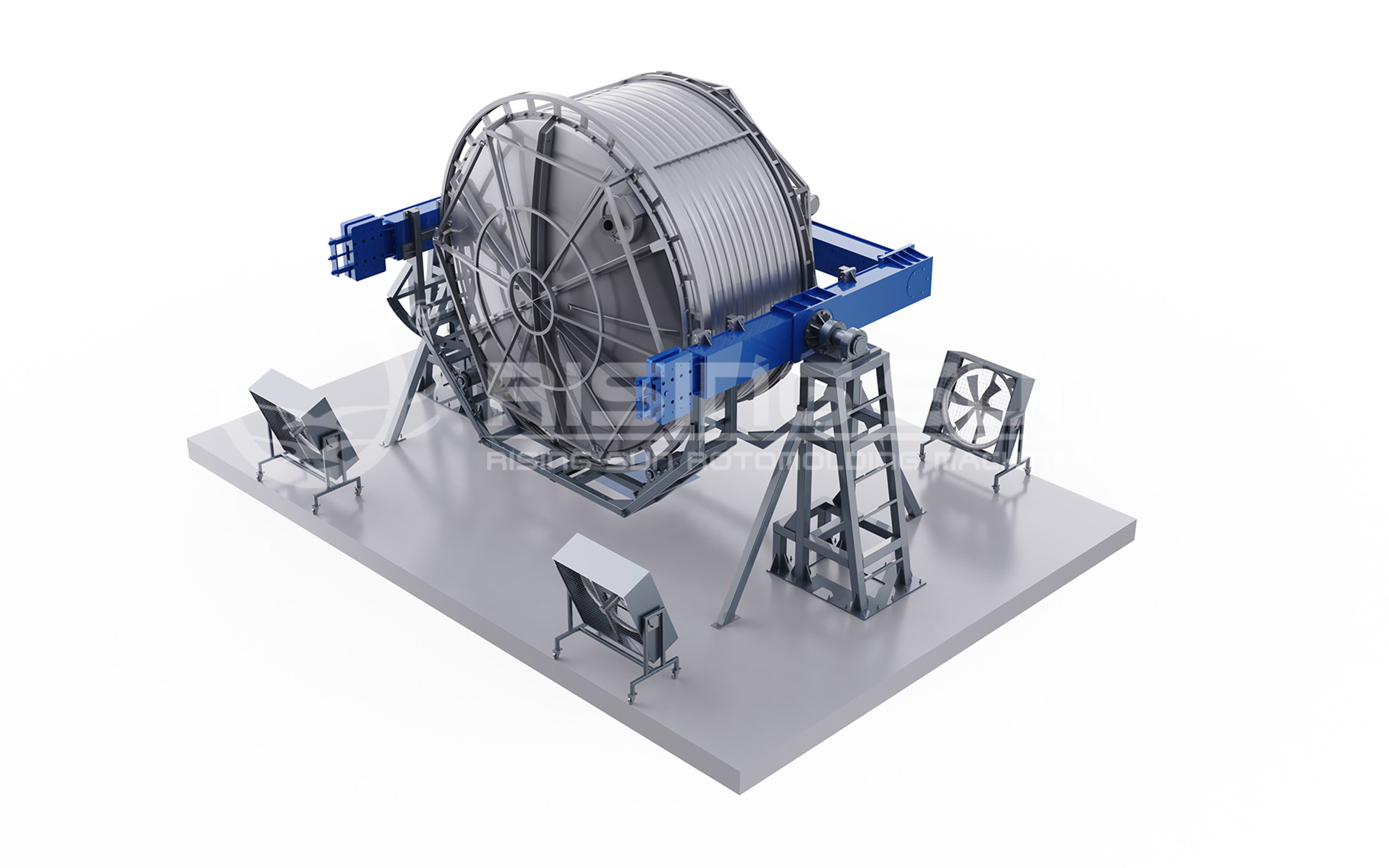
The China U-arm Open Flame RR Machine earns its reputation through a frame geometry that prioritizes rigidity where it matters most. The U-arm casting wraps around the ring rolling zone, cutting lateral deflection during heavy passes and keeping roll gaps stable even when the open flame preheats thick-walled blanks. This structural stiffness directly feeds the second requirement: flame control. The burner manifold sits in a fixed relationship to the roll pass, so the heat pattern does not drift as the shift wears on. Operators report that after the first hour, the flame height and angle remain consistent enough that ring roundness stays within tolerance without constant manual trimming.
On the maintenance side, roll changes follow an alignment routine that feels almost invisible once a crew is trained. The U-arm design exposes the shaft ends without removing the main guard, so swapping rolls for common ring sizes—from small bearing races to larger flanges—takes under twenty minutes. Thermal stress concentrates at the shoulder between the arm and the base plate, and the best Chinese builders reinforce that junction with a stress-relieved fillet rather than a sharp corner. Before buying, check the flame nozzle wear pattern, ask for a ten-hour continuous run video, and inspect the alignment pins for galling. A machine that passes those tests will hold its geometry long after cheaper open-flame units drift out of spec.
Contact Us
Contact Person: Sharon Zhu
Email: [email protected]
Tel/WhatsApp: 8615712666272
Website: https://www.risingsunroto.com