

Collapsible Silicone Kettle Manufacturer Guide to Durable Food-Grade Folding Kettle Design
2026-11-17
Most collapsible kettles promise portability but quietly compromise on taste, durability, or safety. That trade-off is exactly what Qunhao has worked to eliminate in its food-grade folding kettle designs. In this guide, we break down the material choices, hinge and seam details, and quality checks that separate a kettle built for years of real use from one that merely folds.
Choosing Silicone That Survives More Than a Weekend Trip
Most travel silicone gets judged by how it looks in a carry-on, but the real test happens after the third refill, the leaky cap, and the hotel bathroom counter that never quite dries. If the material feels too soft or turns cloudy after a single wash, it will probably start tearing at the flex points before the trip ends. Look for slightly firmer silicone around the neck and collar, with seams that are pressed rather than just glued, because that is where failures almost always start.
Another thing that separates weekend gear from stuff you can keep using is the finish. Cheaper silicone often has a tacky surface that grabs lint and soap scum, and it gets worse with exposure to hard water or sunscreen. A better piece has a smooth, almost powdery feel that stays easy to rinse clean. It should not smell strongly sweet or chemical after sitting in a hot car, either; that usually points to fillers or uneven curing.
Finally, check how the item behaves under pressure. Squeeze it empty, fill it halfway, and flex the spout or closure a few times. If you hear a faint crackle or see whitening at the bends, the material is already stressed. Good silicone should recover its shape without those pale stretch marks, and it should still seal tightly after being dropped or knocked around in a bag for a few days.
Why Foldable Kettles Leak at the Seams First
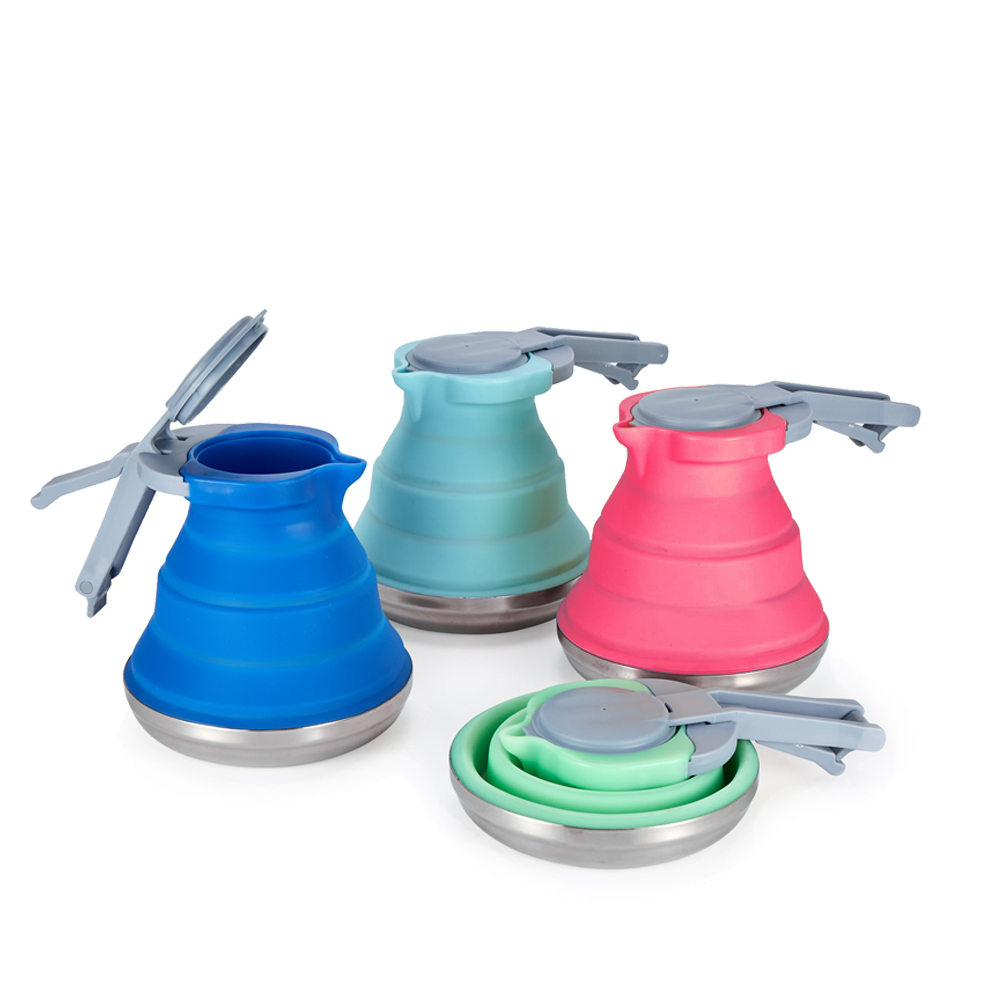
Foldable kettles rarely fail in the middle of the silicone body. They leak at the seam because that is the one place where flexible silicone meets a rigid collar or base. Every heating cycle forces those two materials to expand and contract at different rates. The bond holds for a while, then starts to separate microscopically, long before any visible crack appears.
Collapsing the kettle while it is still warm adds more strain to the same boundary. The silicone folds near the seam work back and forth against the adhesive or welded edge, and minerals from hard water settle into the tiny gap. Over time that deposit acts like a wedge, opening the seal just enough for water to escape. Once a drop gets through, the path widens quickly.
Sharp creases from repeated folding also weaken the material closest to the joint. Silicone that has been bent over and over loses some of its ability to grip the seam tightly, especially if the kettle was not completely dry when stored. That combination of thermal stress, mineral buildup, and fold fatigue is why the first leak usually shows up at the seam rather than anywhere else.
Designing the Collapse Sequence Around Real Kitchen Use
A folding surface in a kitchen rarely gets folded the way a product demo shows. You are mid-recipe, one hand is covered in oil, and the other is holding a knife. The sequence has to work in that condition, not in an empty room. So the release points sit where a wrist or forearm can reach them, and the panels drop in an order that leaves the most-used section available until the last possible moment.
We looked at how people actually move between prep, stove, and sink. The collapse starts from the outer edge, not the middle, because that edge is where clutter piles up first. The inner panel stays put longer since it holds the cutting board and the ingredients already measured out. If someone skips a step or forces the frame, the joints just let the panel swing instead of fighting back.
Cleaning, wiping, clearing. The fold-down has to happen fast, often while food is still on the stove. The latch is loose enough for wet hands but firm enough not to open when a hip bumps into it. That balance matters more than how compact the unit becomes once it is folded.
The Hidden Cost of a Cheap Food-Grade Label
A lower unit price on a food-grade label often disappears the moment those rolls hit a cold, damp production line. Corners lift, adhesives lose grip on condensation-covered packaging, and printed date codes smear into unreadable streaks. What started as a savings in procurement turns into line stoppages, manual re-labeling, and wasted packaging film. The real expense isn't the label itself; it's the labor and downtime needed to fix what a marginally cheaper material should have handled from the start.
There is also a quieter risk that rarely shows up on a purchase order. Inks and adhesives formulated without proper migration testing can interact with fatty or acidic foods, especially when labels are applied under heat or pressure. A single failed compliance audit or a rejected batch can wipe out months of sourcing savings, and in the worst cases, force a full product recall. Those costs arrive without warning and multiply quickly across warehouses, distribution partners, and retail shelves.
Beyond operations and compliance, the label is often the last thing a customer touches before opening a package. When text fades in a refrigerator, barcodes refuse to scan at checkout, or edges peel inside a lunch bag, the perceived quality of the food itself takes the hit. Customers don't see the supply chain; they see a brand that couldn't keep a label intact. That slow erosion of trust is the most expensive line item of all, and it never appears on an invoice.
Stress Points Worth Testing Before the Mold Is Cut
Sharp inside corners, abrupt wall thickness changes, and tall unsupported ribs often hide stress risers that only become obvious after the first shots. A quick FEA pass or even a rough hand calculation on these areas can show whether a boss will crack during ejection or whether a snap detail will survive repeated use. Adjusting a radius or adding a relief before steel is cut costs far less than reworking the tool later.
Prototypes made from printed or machined plastic can not fully reproduce molded-in stress, but they still expose weak geometry. Flexing a hinge, cycling a clip, or pressing on a thin wall a few dozen times tends to reveal failure locations before tooling begins. It also helps to study gate placement and probable weld lines, since those shift the real stress pattern away from the tidy CAD model.
Material choice changes the picture as well. Glass-filled grades feel stiffer but crack more readily at sharp features, while unfilled resins bend more and may creep over time. Testing the actual resin at the intended wall thickness and moisture level gives a truer reading on concentrated stress. If time is short, focus on the three regions that would be most expensive to alter once the mold is cut.
Making the Handle and Rim Outlast the Box It Ships In
Packaging often gets treated as an afterthought, but this piece was built around a simple frustration: the box arrives, the product looks great, and then a few months later the handle starts to wear or the rim shows early stress. So the focus shifted to the parts your hands actually touch. The handle and rim are poured from a denser material blend, then cured more slowly than standard runs. That extra dwell time lets the surface set without micro-fractures, which is where most early cracking begins.
The surface finish also plays a bigger role than most people expect. Instead of a thin spray coating, the rim gets a heat-fused layer that resists scuffs from repeated contact with edges and zippers. The handle hardware is recessed into the body rather than bolted on top, so the load spreads across a wider area instead of concentrating at two small points. You can feel the difference after a few weeks of daily use: no wiggle, no fraying, no glossy patches where the finish has rubbed away.
Testing was deliberately boring. They opened and closed the lid over ten thousand times, hung the handle from a hook with forty pounds of weight for six straight days, and left sample rims in a hot car through a full summer. The goal wasn't a dramatic failure video. It was to make the handle and rim feel the same on day three hundred as they do on day one, even if the shipping box gets torn up and recycled before its first birthday.
FAQ
Food-grade silicone tolerates repeated flexing without splitting, handles boiling water contact without leaching plasticizers, and returns to its collapsed shape quietly. The difference comes down to the platinum-cured material: fewer extractables, better temperature stability, and enough flexibility to fold thousands of times before showing stress marks.
The fold geometry matters more than the silicone durometer. Instead of one sharp crease, use a stepped or radiused accordion profile that spreads stress across a wider band. Tooling should be polished to avoid micro-tears, and the pre-fold should be heat-set so the kettle naturally wants to settle into either open or collapsed position without straining the same edge.
A uniform wall between 1.5 mm and 2.5 mm usually balances flexibility and tear resistance. Too thin creates floppy walls that buckle with hot water, and too thick makes collapsing harder and can hide incomplete cures. Variable thickness at the rim and base gives stiffness where needed without turning the folding section into a crack risk.
A wider base with a low-profile reinforced rim keeps the center of gravity down. Put the handle anchors in the rigid upper band rather than into the folding section, and add a slight inward taper at the top so the weight of the lid and handle presses the body downward instead of tilting it sideways.
Ask for migration testing under boiling-water simulants, not just a raw material certificate. Full-product tests against FDA 21 CFR 177.2600 or LFGB are more meaningful because additives, pigments, and post-curing can change extractables. A reliable factory will also provide batch traceability down to the silicone compound lot.
Usually it is incomplete post-curing or low-quality pigment carriers. Platinum-cured silicone should be baked after molding to drive off volatile siloxanes. If the factory skips that step or uses a peroxide-cured rubber blend, the material can leave a chemical note in boiled water. A sniff test after 24 hours at room temperature often reveals the problem before packaging.
Use targeted thinning at the fold zones while keeping thicker ridges between folds. The thicker ridges act like ribs, guiding collapse into a controlled spiral. A shallow internal stopper near the top fold also prevents over-extension when the kettle is pulled open, which protects the folds from tearing at full stretch.
Inspect fold zones under slight stretch for pinprick holes or white stress marks, fill the kettle with near-boiling water and leave it for 15 minutes to check for leaks or deformation, then run a 50-cycle collapse test on samples from each production shift. Also verify the lid vent opens cleanly so pressure does not force steam through the folds.
Conclusion
Designing a collapsible silicone kettle that lasts starts well before the first prototype hits boiling water. The silicone itself has to earn its place: cheap blends soften, retain odors, or crack after a few trips, so sourcing a high-consistency, peroxide-cured or platinum-cured material with real elongation and tear resistance matters more than any marketing claim. The failure mode almost always shows up at the seams first, which is why seam geometry and bonding need as much attention as the fold lines. A fold sequence that looks clever in a CAD animation can become awkward beside a sink, so the collapse motion should be tested with wet hands, full volumes, and actual kitchen counters rather than a clean studio bench.
The label "food-grade" is not a finish line, and low-cost suppliers often treat it as a checkbox while skipping migration testing or batch consistency checks. Before cutting a mold, it is worth stressing the high-flex zones, handle anchors, and rim edges through repeated boil-dry cycles, cold drops, and pinch folds. The handle and rim are the parts people grab daily, and they should be designed to outlast packaging abuse, not just survive it. A durable folding kettle, in the end, comes from choosing materials for real thermal and mechanical stress, testing failure points early, and treating the collapse sequence as a kitchen habit rather than a gimmick.
Contact Us
Contact Person: Cecilia
Email: [email protected]
Tel/WhatsApp: 8619057488653
Website: https://silwatbottle.com