
Oil-Free Air Blower Factory: Precision Engineering for Pure Air Delivery
2026-07-29
In industries where even a trace of oil can compromise product quality, the demand for truly oil-free air is non-negotiable. At Seize Air, we’ve redefined what it means to deliver purity through precision engineering. Our factory doesn’t just assemble blowers—we craft high-performance air solutions that ensure every cubic meter of air remains uncontaminated. Curious how we achieve absolute reliability without compromise? Step inside our world of advanced manufacturing and discover the meticulous processes behind our oil-free air blowers.
Core Technology Behind Zero-Oil Contamination
Achieving absolutely oil-free compressed air requires a fundamental engineering shift—moving away from lubricated compression chambers to designs that never let oil enter the equation. This begins with precision-machined rotors in dry screw compressors, coated with advanced polymers like PTFE or PEEK, which eliminate metal-to-metal contact without a drop of lubricant. The coating itself becomes the wear surface, enduring millions of cycles while maintaining tight clearances measured in microns. Coupled with this is a cooling architecture that relies entirely on air or water jackets, dissipating the intense heat of compression without oil-based thermal transfer fluids.
Beyond the compression core, sealing technology plays a silent but critical role. Non-contacting labyrinth seals, often made from engineered thermoplastics, create tortuous paths that block any oil vapor migration from external bearings back into the air stream. In rotary vane and scroll compressors, innovative tip seals and spiral geometries ensure that the compression chamber remains isolated. Even the motor design contributes—permanent magnet motors with enclosed stators prevent grease or particles from the drive system from ever reaching the air path. These multiple layers of defense work in parallel, so even if one safeguard experiences wear or unexpected behavior, the system’s integrity holds.
Material science is the unsung hero here. All internal surfaces contacting process air are carefully selected for corrosion resistance and low outgassing, such as stainless steel, anodized aluminum, and specialized composites. This prevents not only oil contamination but also transient chemical residues that could degrade sensitive applications like food packaging or pharmaceutical manufacturing. Real-world validation comes from continuous monitoring—sensors for organic vapor, catalytic analyzers, and dew point meters provide tangible proof that the air remains pure. It’s a symphony of design choices, each removing a potential contamination source, turning the simple idea of “no oil” into a robust, certifiable reality.
Factory Floor: Where Precision Meets Production
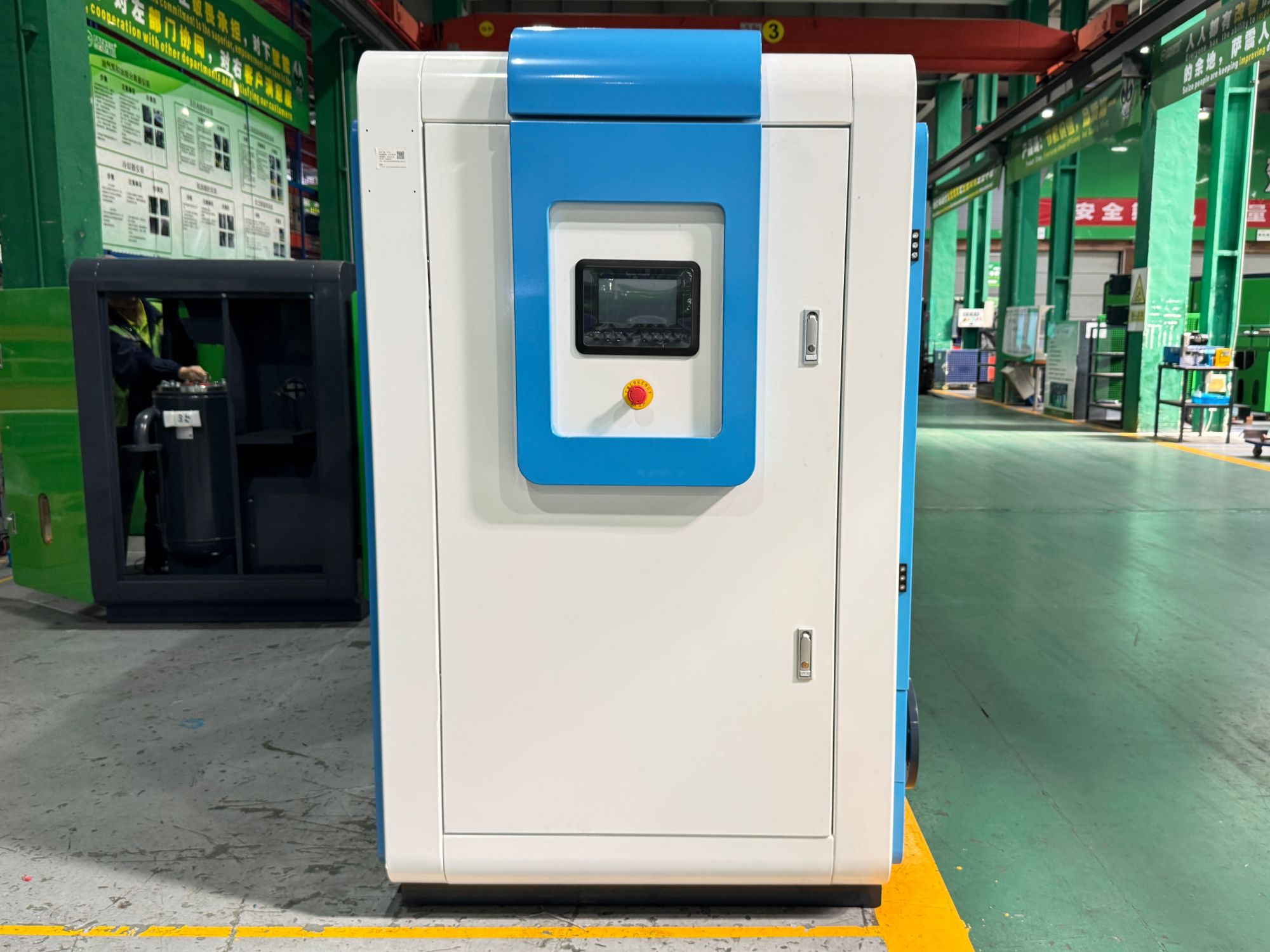
Stepping onto the factory floor, the hum of machinery and the rhythmic dance of automated arms immediately signal a space where craftsmanship is elevated by technology. Here, raw materials are transformed with exacting standards, each station calibrated to micron tolerances. It's not just about assembly lines; it's a choreographed environment where human oversight and robotic efficiency blend seamlessly, ensuring every product that rolls off the line carries a mark of deliberate excellence.
What truly sets this floor apart is the invisible layer of real-time data interwoven with physical processes. Sensors embedded in equipment whisper performance metrics to a central nervous system, allowing adjustments on the fly without disrupting output. Workers, equipped with augmented-reality overlays, see beyond the surface—identifying potential flaws before they manifest. This fusion of digital foresight and manual dexterity means the floor doesn’t just react; it anticipates, morphing challenges into opportunities for refined output.
Amidst the orchestrated chaos, there's an unexpected quiet confidence. Veteran machinists confer with AI diagnostic tools, treating the floor as a living ecosystem rather than a static production line. Every corner tells a story of continuous improvement—from the custom jigs that evolved from years of floor-led innovation to the sustainable practices quietly embedded in every stage. This is where blueprints materialize into tangible quality, a testament to the belief that true precision isn’t an act but a habit cultivated daily.
Custom Engineering for Industry-Specific Demands
Every industry operates under a unique set of constraints—whether it's the stringent hygiene standards of food processing, the uncompromising safety requirements in oil and gas, or the extreme precision demanded by semiconductor manufacturing. Off-the-shelf solutions rarely account for these nuances, which is why we immerse ourselves in the operational reality of each sector. By combining deep domain knowledge with cross-disciplinary engineering expertise, we design systems that don't just meet specifications but anticipate the unspoken challenges of a given environment.
This approach goes beyond modifying standard components; it often means rethinking fundamental architectures to align with material compatibility, regulatory frameworks, or workflows that have evolved over decades. Our team thrives on translating complex, real-world constraints into robust, scalable machinery that integrates seamlessly and performs reliably under the most demanding conditions. The result is not a generic product forced to fit, but a purpose-driven solution that feels native to its intended setting.
Rigorous Testing Protocols for Unmatched Air Purity
Every unit undergoes a barrage of assessments that go far beyond industry norms. We simulate extreme environments—blasting fine particulate matter, volatile organic compounds, and microbial aerosols through the filtration system while monitoring performance in real time. Sensors track particle counts down to 0.1 microns, and data is logged continuously to catch even transient dips in efficiency. This isn't a one-and-done check; it's an ongoing stress test that pushes the hardware to its limits, ensuring the air you breathe is genuinely clean, not just meeting a baseline spec.
Our protocols also incorporate long-duration endurance trials that mimic years of real-world use in a compressed timeframe. Filters are subjected to cyclic loading—alternating between heavily polluted and clean air streams—to evaluate how they hold up when the going gets tough. We measure pressure drop evolution, dust-holding capacity, and fractional efficiency across multiple particle sizes, flagging any degradation before it would ever affect a user. By the time a product earns its certification, it has proven itself not just in a lab, but in conditions harsher than any home or office.
What sets our approach apart is the layer of biological and chemical challenge testing. We introduce live bacteria, mold spores, and allergy-triggering proteins into the airstream, then verify that downstream air is virtually sterile and free of irritants. Off-gassing tests run for weeks to screen for any trace of formaldehyde, benzene, or other unwanted byproducts. Every result is cross-validated by independent third-party labs, and we publish the full data sets—no cherry-picking, no asterisks. It's an uncompromising process, but it's the only way to deliver air purity that's truly unmatched.
Energy Efficiency Without Compromising Performance
Achieving energy efficiency in modern devices often sparks a debate between conserving power and maintaining top-tier speed. Many assume that dialing down consumption inevitably leads to sluggish performance, but smarter engineering has turned that notion on its head. By rethinking how hardware and software interact, we can unlock systems that sip power while still delivering the responsiveness users demand.
Take adaptive power management, for instance. Instead of a one-size-fits-all approach, components adjust their energy draw based on real-time workload. A processor might run at a fraction of its capacity while handling emails, then instantly ramp up when video editing or gaming requires a burst of muscle. This fluid scaling ensures no watt is wasted, yet the user experience remains seamless.
Ultimately, the key lies in intelligent design that prioritizes both efficiency and power. From ultra-low-power sleep states that wake in milliseconds to advanced cooling solutions that prevent throttling, the goal is to eliminate the trade-off altogether. The result? Devices that run cooler, last longer on battery, and never make you choose between sustainability and speed.
Global Service Network and Lifecycle Support
From initial consultation to decommissioning, our support structure is built around your operational reality. We don't just react when something breaks—we embed local engineers and technical advisors who understand your environment, your standards, and the unique pressures of your industry. This proximity isn't just about speed; it's about context. Whether you're commissioning a new line in Southeast Asia or sustaining legacy equipment in South America, the team you speak with already knows the history of your assets, your uptime metrics, and your maintenance culture.
That depth of integration extends into how we handle the full lifecycle. Instead of treating support as a series of transactions, we map out a continuum of services—proactive health checks, predictive parts staging, performance audits at predictable intervals—that evolve as your equipment ages. If a particular drive unit shows a pattern of wear at 20,000 hours in a specific climate, our network spots that and pre-positions the right components before you ever see an alert. The goal is to make support feel invisible: you stay focused on throughput, and we quietly manage the technical arc of every asset under our care.
Behind this is a network that refuses to be siloed. Our field teams, remanufacturing centers, and engineering hubs operate as one organism. A diagnostic insight from a technician in one hemisphere refines the training curriculum for another region within days. A retrofitting project that starts in Europe gets replicated with local materials and local labor in Africa, without reinventing the wheel. It's a model that doesn't just sell you parts or labor hours—it gives you a living system of expertise that gets sharper the longer we work together.
FAQ
These blowers are built from the ground up without any oil-based lubrication systems. Instead, we use advanced dry-running technology and precision-engineered components that eliminate the risk of oil contamination entirely. The result is a cleaner, more reliable air supply that outperforms conventional models in sensitive environments.
Every rotor, chamber, and seal is machined to micron-level tolerances using state-of-the-art CNC equipment. This precise fit minimizes internal leakage and friction, so no oil is needed to seal or cool the moving parts. The airtight design ensures that the air stream remains uncontaminated from intake to outlet.
Industries where air purity is critical benefit the most—think food and beverage processing, pharmaceutical manufacturing, electronics production, and wastewater treatment. In these sectors, even trace amounts of oil can ruin products or disrupt processes, so our blowers provide a vital assurance of clean air.
All major components are machined and assembled in-house under strict climate-controlled conditions. After assembly, each blower undergoes multiple tests: dynamic balancing, pressure and flow verification, and a final particle count analysis to confirm oil-free output. Only units that pass every stage are cleared for shipment.
The main advantage is total elimination of oil carryover—no filters to change, no oil disposal costs, and no risk of product spoilage. Additionally, oil-free blowers typically require less routine maintenance, run quieter, and maintain consistent performance over a longer lifespan because there’s no oil degradation to manage.
We incorporate multiple layers of protection: the core design avoids all liquid lubricants, external cooling systems isolate any potential lubricated bearings from the air path, and every finished blower is tested with a laser particle counter to certify zero oil aerosol in the discharge air.
Absolutely. We offer a modular platform where customers can specify airflow rates, pressure levels, motor types, and even the materials of construction for corrosive environments. Our engineering team also collaborates on custom inlet and outlet configurations to integrate seamlessly with existing plant layouts.
Routine maintenance is straightforward: periodic inspection of inlet filters, checking alignment and belt tension (if applicable), and monitoring vibration levels. Because there’s no oil to change or seals to lubricate, the main task is simply keeping the external cooling fins clean to ensure proper heat dissipation.
Conclusion
The relentless pursuit of air purity begins deep inside the core engineering of our oil-free blowers, where rotating assemblies are designed with advanced air-bearing or magnetic-levitation systems that completely eliminate the need for lubricants. Every component—from high-speed permanent-magnet motors to precisely machined impellers—is crafted to ensure that not a single trace of oil vapor enters the airstream. On the factory floor, climate-controlled cleanrooms and automated five-axis CNC centers turn raw alloys into micron-level components, while laser alignment tools and in-process metrology stations verify geometric accuracy at every step. Skilled technicians marry digital twins with hands-on expertise, tracing each build back to its unique serial profile so that performance deviations become virtually impossible.
Beyond the common catalog, our engineers dive deep into the specific needs of wastewater treatment plants, food and beverage packaging lines, pharmaceutical fermentation, and semiconductor fabs, often co-developing blade geometries, coating formulas, and integrated controls that match exact flow, pressure, and chemical resistance profiles. Prototypes then face a gauntlet of tests in soundproofed cells: ISO 8573-1 Class 0 certification runs alongside accelerated-life trials, particle counts, and real-time efficiency mapping under extreme temperature swings. By coupling variable-speed drives with wake-turbulence-optimized diffusers, we routinely achieve energy savings over thirty percent compared to fixed-speed alternatives, all without sacrificing a cubic foot of clean air. Should an anomaly ever surface, our global support teams reach the site within hours—armed with remote diagnostics that have already pinpointed the issue—ensuring that pure, uninterrupted delivery stays that way for decades.
Contact Us
Contact Person: Mia
Email: [email protected]
Tel/WhatsApp: +86 19821985894
Website: https://www.seize-air.com