
Smart Bus Stop OEM: How Custom Manufacturing Powers Intelligent Public Transit
2026-09-24
Every smart bus stop starts as a pile of specs, a city's wish list, and a tight deadline. Turning that into a weatherproof, real-time transit hub isn't about off-the-shelf parts - it's about OEM precision. At zemso, custom manufacturing bridges the gap between ambitious public transit goals and hardware that actually survives the street. Here's what that looks like.
From Concept to Concrete: How Custom Bus Stop Designs Take Shape
Most custom bus stops don’t begin with a grand blueprint. They start as a scribble on a napkin, a photo of a crowded curb at 6 p.m., or a complaint overheard at a community meeting. Designers spend days just watching how people actually use a corner—where they stand when it rains, where they lean when they’re tired, and how far they’re willing to walk to avoid a puddle. Those rough sketches, often messy and full of crossed-out lines, set the tone for everything that follows. Whether the final shelter ends up as a sharp steel wedge or a timber-framed nook with built-in planters depends almost entirely on those first, unglamorous observations.
Once a concept survives the sketch stage, it gets tested with cheap materials and fast mock-ups. A full-scale cardboard canopy might be propped up overnight just to see how shadows fall at noon. Some studios 3D-print tiny models to check proportions, then move to a single leg or roof section built from actual steel or concrete. This is where a lot of ideas die quietly—what looked sleek on screen can feel oppressive in real life, or a clever shape might block a driver’s sightline. Revisions happen daily, often with a welder standing by, cutting and re-welding until the structure feels right from every angle.
Installation day is never the finish line. The designer usually shows up with a tape measure and a notebook, watching the first buses pull in. A seat that felt perfect in the workshop might be two inches too low for an elderly passenger. A roof that looked generous on paper might still let rain blow in from the west. So the tweaking continues on site—grinding a sharp edge, shifting a map panel, or moving a bike rack three feet to the left. This back-and-forth gives each custom stop a particular roughness, a sense that someone actually stood there and made decisions with their hands. And that’s what separates a bespoke shelter from a generic one bolted together from a catalog.
Beyond a Shelter: Engineering Smart Displays and Sensors Into Street Furniture
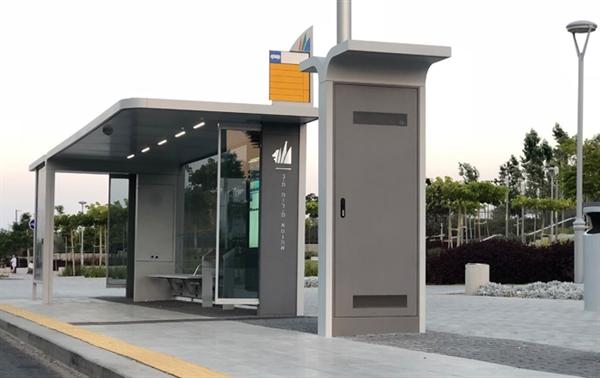
A bus stop or bench that only shields you from rain is no longer enough. Embedding displays and sensors into these everyday structures means rethinking how they handle weather, power, and constant public contact. The display glass has to survive UV exposure, temperature swings, and the occasional kick without turning into a scratched, unreadable surface. Sensors, whether tracking air quality or counting foot traffic, need to sit inside enclosures that look like part of the furniture rather than bolted-on afterthoughts.
One practical route is modular construction. Instead of building a one-off smart bench, cities can use street furniture with standardized slots for e-paper panels, edge computing boards, and battery packs. If a sensor fails or a newer display becomes available, the module slides out and a replacement slides in, leaving the bench or shelter frame untouched. Wiring runs through sealed channels inside the frame, so there are no external cables to snag or tamper with.
The harder part is tuning the whole system for real street conditions. Noon glare calls for automatic brightness adjustment or matte anti-reflective coatings. Dust and humidity require gasketed housings and sometimes heating elements to prevent condensation on sensor lenses. When these details are handled well, a bus shelter stops being a passive structure and starts functioning as a quiet local data node, offering departures, hyperlocal weather, or even wayfinding without adding visual clutter.
Material Choices That Survive Weather, Vandalism, and Time
Concrete gets dismissed as dull until you compare a thirty-year-old bench in a coastal park with its wooden counterpart three blocks inland. The concrete slab still holds its edge; the timber slats have warped, split, and hosted rot. For public seating, railings, and bollards, precast concrete mixed with a low water-cement ratio shrugs off salt spray, freeze-thaw cycles, and the occasional kicked skateboard. It doesn't need annual sealing, and when graffiti appears, a pressure washer or a coat of anti-graffiti paint restores it without degrading the surface. If you want the warmth of wood, specify acetylated wood or thermally modified ash—both resist moisture and fungal decay far longer than pressure-treated pine, though they will still show scuffs from bike locks and pocketknives.
Powder-coated steel and anodized aluminum solve different problems. Steel earns its keep when welded into bollards or fence posts, but only if the zinc-rich primer and polyester topcoat are applied over a properly blasted profile—skip that step and rust creeps from every scratch. Anodized aluminum, on the other hand, never rusts and laughs off UV exposure, which is why it works for window frames, signage, and light poles in humid or marine environments. The trade-off is that aluminum dents more easily, so avoid it for anything that might be rammed by a delivery truck or used as a bike rack. For those high-impact spots, ductile iron or thick-wall stainless steel costs more upfront but survives decades of abuse without needing a repaint.
Then there are the quiet workhorses: stone, brick, and fiber-reinforced polymer. Granite curbs and sandstone pavers have already proven themselves over centuries—they don't care about UV, acid rain, or frost, and their scratches read as patina rather than damage. Fiber-reinforced polymer (FRP) is less familiar but increasingly useful for handrails, decking, and benches in coastal or chemically aggressive settings. It won't rot, corrode, or conduct electricity, and it can be molded to mimic wood grain convincingly enough to fool a casual glance. The catch is that FRP can fade and chalk under strong sun unless specified with a UV-stabilized gel coat, and it lacks the mass that makes stone feel permanent. Matching the material to the specific threat—salt, impact, fire, or bored teenagers—remains the real design skill.
The Connected Commute: How Live Data Changes the Waiting Experience
Standing on a platform with no idea when the next train will arrive used to turn a five-minute wait into a slow burn of glances at the clock. Live data strips away that guesswork. When a countdown appears on the platform screen or your phone shows the bus two stops away, the waiting itself becomes less of a passive limbo. You know whether to grab a coffee, send a message, or simply breathe for a minute before the doors open.
Real-time feeds do more than display numbers. They reshape how commuters make small decisions throughout the day. A delayed train no longer means standing frozen in place; it means rerouting to a nearby line, adjusting a meeting call, or stepping into a shop instead of hovering by the entrance. The information turns an uncertain gap into usable time, which matters more than the raw minutes saved.
Transit agencies that push live data to every surface—apps, signs, even voice assistants—build a different kind of trust. The commute feels less like a system doing something to you and more like a system you can read. That shift is subtle, but for anyone who has ever watched an empty track and wondered if they should just start walking, it changes the entire tone of the journey.
Low Volume, High Flexibility: Adapting OEM Production to City-Specific Needs
Urban markets rarely reward one-size-fits-all manufacturing. A scooter model that sells briskly in Manila’s narrow alleys may sit untouched in a sprawling Bangkok suburb, where riders expect longer seat cushions and sturdier suspension for uneven side streets. Low-volume OEM production flips the traditional factory logic: instead of chasing scale to lower unit cost, it treats every city as its own product brief. Runs of a few hundred units become not a compromise but a deliberate strategy, allowing line changes in hours rather than weeks and warehousing that hugs local demand curves rather than guessing them months ahead.
This approach demands a different kind of tooling mindset. Modular jigs, quick-change fixtures, and operator-led setup replace the hard automation built for million-unit runs. A factory producing e-trikes for Jakarta and Hanoi might share the same chassis platform while swapping out footboards, battery mounts, and lighting clusters to match local regulations and rider habits. The flexibility isn’t just physical—it extends to procurement, where smaller batch orders of region-specific components sit alongside common parts bins. The result is a production line that behaves less like a monolith and more like a short-order kitchen, capable of plating a dish for one neighborhood without shutting down the grill.
Cost discipline comes from elsewhere: standardized subassemblies, lean changeover rituals, and a workforce cross-trained to shift between product variants without losing rhythm. When volume stays low, the old metric of units-per-hour becomes less meaningful than setups-per-day or variants-per-week. City-specific OEM work thrives on this inversion, turning what high-volume plants call inefficiency into a competitive edge. It’s less about making many of one thing and more about making the right few things for each place—without waiting for a national trend to justify the run.
Scaling From Pilot to Citywide Rollout Without Losing Custom Quality
Expanding from a single pilot neighborhood to an entire city usually means trading the hand-stitched feel of early work for mass-produced sameness. The real challenge isn't adding more crews or software licenses—it's keeping the specific details that made the pilot feel tailored while replicating them across dozens of distinct districts. One approach is to treat the city not as one big canvas but as a collection of pilots. Each district gets its own working group, its own feedback loops, and its own local tweaks, even though the underlying framework stays consistent. That way, a bike lane in the old town doesn't end up looking identical to one in a new suburb; it fits the street, the traffic, and the people who actually use it.
Another piece that often gets overlooked is documentation without over-standardization. Instead of writing a 300-page manual that nobody reads, we capture decisions as short, visual case notes. When a crew in one neighborhood solves a drainage problem or adjusts a bench height for elderly residents, that fix gets logged with photos and a two-sentence explanation. Other teams can borrow the idea, but they're encouraged to adapt it, not copy it wholesale. This keeps the rollout moving fast but leaves room for local judgment.
Finally, quality doesn't scale by adding more inspectors at the end. It scales by giving the frontline teams—the ones pouring concrete or planting trees—the authority to flag when a standard detail doesn't fit their site. A weekly ten-minute call between district leads can replace months of rigid audits. The goal isn't perfect uniformity; it's a city that feels coherent but not stamped out. When residents can point to their own block and say "this was made for us," the pilot didn't just scale—it grew up.
FAQ
Standard kiosks rarely match the street layout, power constraints, or harsh local weather. Custom manufacturing lets agencies specify enclosure dimensions, mounting points, screen orientation, and even the exact shade of paint so the stop feels like part of the neighborhood rather than a generic add-on.
A bespoke enclosure can use thicker aluminum, gasketed seams, UV-stable coatings, and internal heating or cooling loops. These choices are driven by the stop's actual location, whether that means salt spray near the coast, desert dust, or sub-zero winters, so components stay within safe operating ranges longer.
Modular frames and swappable component bays let operators replace a failed screen, upgrade a cellular radio, or add a new sensor without tearing out the whole stop. This reduces the time a stop is out of service and avoids expensive full-unit replacements as technology evolves.
Yes, custom designs can mix solar, battery, and grid power in one unit. A manufacturer might place panels on a curved canopy, route wiring through a hollow mast, and include smart charge controllers tuned to local sun hours, so the stop stays online even during brownouts or cloudy stretches.
Custom manufacturing allows for tactile buttons at wheelchair height, high-contrast e-paper displays for bright sunlight, audio jacks or speakers for spoken announcements, and braille labels that align with the actual UI. These details are easier to integrate when the housing and interface are designed together.
Beyond basic electronics testing, manufacturers should run thermal cycling, rain and dust ingress tests, vibration tests on mounting brackets, and accelerated UV aging on plastics and paints. Each unit should also undergo a full system boot and communication check before crating, since field repairs are far costlier.
A custom-built stop can house multiple sensors, such as passenger counting cameras, environmental monitors, and occupancy detectors, in positions that avoid blind spots. The OEM can also isolate antennas from metal framing and route cables cleanly, which means stronger signals and more reliable data feeds for real-time tracking.
Conclusion
The journey from a city's rough concept to a finished smart bus stop rarely follows a straight line. OEM manufacturers sit down with transit agencies and local designers early, interpreting curb heights, pedestrian flow, and even historic district rules before metal is cut. That early collaboration shows up in details like curved roofs that channel rainwater away from waiting riders, or sensor housings recessed into the frame so they don't invite vandalism. Displays, touchscreens, speakers, air quality monitors, and USB ports are not afterthoughts bolted on later; they are integrated into the structural design from day one, with hidden cable runs and service panels that maintenance crews can open without special tools. Material choices then become a quiet form of insurance. Powder-coated galvanized steel resists coastal salt, tempered glass shrugs off thrown rocks, and anti-graffiti films make cleaning a five-minute job. Some stops even use recycled aluminum or locally sourced timber for cladding, satisfying city sustainability goals without compromising durability.
Once live data enters the picture, the waiting experience changes fundamentally. A rider can glance at a sunlight-readable e-ink display and see not just the next bus, but whether that bus is crowded, delayed by an accident, or arriving early enough to grab a coffee. Environmental sensors feed noise and air quality readings to the same screen, giving the stop a second life as a neighborhood information point. For OEM production, this level of integration means low-volume flexibility is not a luxury but a baseline requirement. One district may need a stop with an induction loop for hearing aid users and tactile paving integration; another may request a solar canopy and battery backup for off-grid locations. A manufacturer that can adjust bracket spacing, panel dimensions, or antenna placement between orders without starting from zero keeps both the pilot and the eventual citywide rollout moving. Scaling up then becomes less about stamping out identical units and more about preserving the custom logic of each neighborhood. With shared core electronics, firmware, and quality checks in place, hundreds of stops can be deployed across a city while still reflecting local materials, signage languages, and even different roof profiles. That balance of repeatable engineering and site-specific fabrication is what separates a true OEM partner from a generic kiosk supplier.
Contact Us
Contact Person: Leo
Email: [email protected]
Tel/WhatsApp: +86 18901905138
Website: https://www.zemsogroup.com/