

Top Aromatic Acetoxy Intermediate Applications and Benefits
2026-08-21
Aromatic acetoxy intermediates have quietly become the backbone of many advanced chemical processes, yet their full potential often goes unnoticed. From enhancing pharmaceutical synthesis to streamlining agrochemical production, these versatile compounds deliver both performance and efficiency. In this post, we’ll explore the top applications and benefits that make them indispensable—and why sourcing from a reliable partner like DSL Chemicals can make all the difference in your next project.
Where Aromatic Acetoxy Intermediates Fit in Medicinal Chemistry
Aromatic acetoxy groups often appear when a phenol needs to be carried through multiple synthetic steps without interference. In medicinal chemistry campaigns, phenols are notorious for oxidation, glucuronidation, and other metabolic liabilities, so protecting them as acetates can keep intermediates stable and easier to purify. The acetate is cheap, introduces minimal steric bulk, and comes off under mild basic conditions that leave most other functionality untouched—useful when a late-stage scaffold already carries fragile heterocycles or stereocenters.
Beyond protection, the acetoxy substituent can act as a deliberate point of reactivity. Aryl acetates undergo metal-catalyzed cross-coupling after C–O activation, turning what might be a metabolic weak spot into a handle for diversification. They also show up in prodrug designs where enzymatic hydrolysis releases the free phenol at a controlled rate. In early lead optimization, acetylating a phenolic library is a practical tactic to buy time against rapid clearance, letting the team probe target engagement before committing to more elaborate phenol bioisosteres.
How Acetoxy Groups Unlock Faster, Cleaner Coupling Reactions
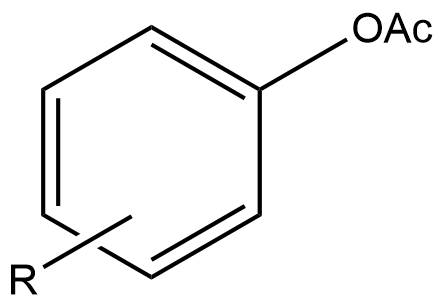
Halide-based cross-couplings have dominated synthetic chemistry for decades, yet the stoichiometric halide waste they produce is increasingly hard to justify. Swapping an aryl halide for an aryl acetate flips this equation: phenols, which are abundant and often renewable, can be acetylated in a single step to give bench-stable, crystalline substrates. Under nickel catalysis, the C(aryl)–O bond in these acetoxy derivatives undergoes surprisingly facile oxidative addition. The result is a coupling platform that sidesteps halogenated starting materials entirely, while often reaching completion in less time than the corresponding bromide or iodide.
The cleanliness of acetoxy-based couplings stems from the fate of the leaving group. Instead of generating metal halide salts or corrosive hydrogen halides, the acetate fragment is released as acetic acid or a simple acetate salt, both of which are easy to separate and far less toxic. This benign byproduct profile shortens work-up procedures and reduces the need for extensive chromatography. Moreover, aryl acetates tend to be less prone to unwanted side reactions such as protodehalogenation or homocoupling, which means fewer impurities and a smoother path from crude mixture to pure product.
Ligand design plays a decisive role in unlocking the speed of these reactions. Bulky, electron-rich N-heterocyclic carbenes and certain biarylphosphines stabilize the nickel center just enough to promote insertion into the C–O bond without stalling the catalytic cycle. Under these conditions, aryl acetates couple efficiently with boronic acids, organozinc reagents, and even amines at or near room temperature. The combination of fast kinetics, mild conditions, and a non-halogen leaving group makes acetoxy-based coupling a practical alternative for both discovery-scale synthesis and larger preparative work.
The Stability Benefit: Protecting Fragile Intermediates During Synthesis
Many synthetically valuable intermediates are inherently short-lived, and their survival depends on how quickly and carefully they are handled after formation. Organolithium species, enolates, and certain carbocations, for instance, can decompose via proton transfer, elimination, or self-condensation if the local environment is not tightly controlled. The stability benefit in synthesis arises when a reaction setup is deliberately tuned to preserve such intermediates—typically through low temperatures, anhydrous solvents, and an inert atmosphere—so that they remain intact just long enough to participate in the intended bond-forming step. Without this protection, even a well-planned route can collapse at the very point where the reactive species is generated.
One practical way chemists exploit this benefit is by using in situ generation paired with immediate consumption. For example, a lithiated intermediate formed at −78 °C can be quenched within seconds by adding an electrophile to the same flask, preventing it from abstracting a proton from the solvent or attacking another molecule of starting material. Flow chemistry takes this further by reducing residence time to milliseconds, allowing intermediates that would never survive in a batch reactor to be captured reliably. Protecting groups serve a related role: they mask functional groups that would otherwise destroy a fragile intermediate through intramolecular reactions, giving the desired pathway a kinetic advantage. These strategies turn instability from a liability into a controllable variable.
The downstream consequences of stabilizing fragile intermediates are often visible in both yield and purity. When side reactions are suppressed, fewer byproducts form, which means less chromatographic effort and fewer losses during purification. A process that reliably protects a sensitive intermediate also scales more predictably, because the key reactive species behaves the same way in a 5-gram run as it does in a 500-gram run. For medicinal and process chemists, this consistency is often more valuable than a modest yield improvement, since it reduces batch failures and makes the overall route more robust. In that sense, the stability benefit is less about keeping a molecule alive for its own sake and more about preserving the integrity of the entire synthetic sequence.
Scaling Up Aromatic Acetoxy Chemistry Without Losing Reproducibility
Moving a Suzuki coupling with an acetoxy-substituted aryl bromide from a 100 mL flask to a 20 L reactor usually means the reaction no longer behaves the same way. The issue is rarely the chemistry itself but how slowly the reactor can add the boronic acid, how unevenly the base gets suspended, and how much longer the aqueous workup takes. In small flasks, a 5-minute addition and a brisk stir mask a lot of hydrolysis of the acetoxy group; at scale, that same group sits in hot aqueous base for an extra hour and gets chewed away. Reproducibility falls apart unless you deliberately drive the acetoxy hydrolysis to a known endpoint or strip water before it can attack the ester.
One practical fix is to switch to azeotropic drying of the aryl bromide and solvent before the metal catalyst goes in, then use a controlled feed of the boronic acid over at least 30 minutes rather than dumping it in. We found that keeping the internal temperature 8–10°C lower than the original lab protocol compensates for the longer residence time and reduces black tar formation. Monitoring the aryl acetate peak by HPLC at 15-minute intervals gives an early warning if the acetoxy group starts to drift, allowing you to cut the base charge or speed up the filtration before the impurity profile locks in.
Cutting Solvent Use and Energy Costs with Acetoxy-Based Routes
Acetoxy cure chemistry removes a surprising amount of thermal load from production because it does not need the prolonged bake cycles that many solventborne or neutral-cure systems require. The acetoxy group reacts quickly with atmospheric moisture at room temperature, so coated or sealed parts can leave the line without waiting for solvent flash-off or an elevated-temperature cure. This directly trims energy consumption while also reducing solvent inventory and the associated handling costs.
The savings grow when you consider what disappears from the process entirely: solvent recovery equipment, distillation energy, and the ventilation capacity needed to keep solvent vapors under control. Acetoxy formulations can often be applied at much higher solids or even as neat liquids, which means fewer passes and less energy per square meter of finished surface. In practice, converting a line often pays back faster than most neutral-cure alternatives because the reduction in both energy and solvent use hits the same budget line.
There is still the acetic acid odor to manage during the first stage of cure, but this is usually handled with local exhaust rather than plant-wide air handling. Once that is accounted for, the overall energy profile tends to favor acetoxy routes, especially for high-volume sealing, bonding, or coating work where small per-unit savings compound quickly.
Unexpected Roles in Polymer and Agrochemical Innovation
When most people think about polymer innovation, they picture a chemist tweaking monomers in a lab. Yet some of the most consequential shifts have come from places few would expect—think textile waste streams being repurposed as feedstock, or enzymes discovered in deep-sea microbes that now catalyze industrial polymerization. These odd bedfellows don't fit the standard R&D narrative, but they've quietly rewritten what's possible.
The same holds true in agrochemicals. Crop protection breakthroughs have been driven less by classic synthesis and more by insights from ecology, data science, and even video game physics engines repurposed to model spray drift. A surprising source of innovation has been the behavioral study of pest resistance—not in field trials, but in simulated environments built by game developers. This cross-pollination keeps yielding formulations that are both more effective and less environmentally intrusive.
What these unexpected roles share is a willingness to overlook disciplinary boundaries. The polymers and agrochemicals of the next decade won't come from a single eureka moment in a flask; they'll emerge from collaborations that seem almost accidental—until they become indispensable.
FAQ
They are organic compounds featuring an acetoxy group (-OCOCH3) attached to an aromatic ring or side chain. Their significance comes from the ability to mask reactive hydroxyl groups, enabling selective transformations in multi-step synthetic routes.
Pharmaceuticals, agrochemicals, and fine fragrance sectors are the biggest users. In drug manufacturing they serve as protected phenols, in crop protection they enable prodrug strategies, and in perfumery they act as controlled-release precursors for delicate aroma chemicals.
They act as temporary protecting groups for phenolic hydroxyls, allowing chemists to perform reactions at other positions without unwanted side reactions. Later the acetoxy group can be removed under mild conditions, increasing overall yield and purity.
Acetoxy derivatives of aromatic alcohols often have lower volatility and higher stability than the parent aroma compounds. When exposed to moisture or enzymes on skin or in formulations, they hydrolyze slowly, releasing the active scent over an extended period.
4-Acetoxybenzaldehyde is a common example. It is used in the synthesis of various pharmaceuticals and liquid crystal materials, and also serves as a building block for vanillin-type flavor compounds.
Acetoxy groups are inexpensive to introduce, stable under acidic and neutral conditions, and can be selectively removed by mild alkaline hydrolysis or enzymatic cleavage. They also have low toxicity and generate acetic acid as a byproduct, which is easy to remove.
Most aromatic acetoxy intermediates are low to moderately toxic, but they should be handled with standard chemical hygiene practices. Because they can hydrolyze to release acetic acid, storage should avoid moisture and strong bases. Proper ventilation and personal protective equipment are recommended.
The acetoxy group increases lipophilicity and reduces hydrogen bonding compared to free hydroxyls, improving solubility in organic solvents and membrane permeability. This makes intermediates more suitable for certain coupling reactions and formulation development.
Conclusion
Aromatic acetoxy intermediates have quietly become indispensable across several branches of synthetic chemistry. In medicinal chemistry, they serve as versatile handles for late-stage functionalization—acetoxy groups can be swapped out under mild conditions to install amines, ethers, or carbon bonds without wrecking a carefully built scaffold. Because the acetoxy leaving group is both small and electronically tunable, coupling reactions run faster and produce fewer side products, which means less time spent on chromatography and higher yields at the end. Another underappreciated advantage is stability: attaching an acetoxy group to a phenol or hydroxyl-bearing aromatic ring shields that position from oxidation or unwanted nucleophilic attack during multi-step sequences. This lets chemists carry fragile intermediates through several transformations and only reveal the reactive site when it is actually needed.
Beyond the lab bench, these intermediates shine in process chemistry. Scaling up acetoxy-based routes tends to be more reproducible than alternatives because the reactions are less sensitive to trace moisture or oxygen, and the byproducts—typically acetic acid or acetate salts—are easy to remove. That translates directly into lower solvent consumption and energy costs, since workups are simpler and fewer purification steps are needed. Interestingly, the same chemistry has found unexpected homes in polymer science and agrochemical development. In polymer synthesis, aromatic acetoxy groups can act as thermally or photochemically labile protecting groups, enabling controlled crosslinking or chain-end modification. In agrochemicals, they offer a route to pro-drug-like active ingredients that release the active phenol or carboxylic acid upon contact with plant or soil enzymes, improving uptake and reducing off-target effects. Together these benefits explain why aromatic acetoxy intermediates remain a go-to tool when efficiency, stability, and cost all matter.
Contact Us
Contact Person: Wei Zhang
Email: [email protected]
Tel/WhatsApp: 862163529955
Website: https://www.dslchem.com