

Wholesale RCBO: Smart Buying Tips for Electrical Suppliers and Contractors
2026-11-02
Buying RCBOs wholesale can feel like a numbers game, but the cheapest quote often hides the steepest costs—failed inspections, callbacks, and unhappy clients. If you’re an electrical supplier or contractor planning your next bulk order, it pays to look past the unit price and focus on what actually keeps a circuit safe and a project on schedule. Here, we’ll walk through the smart buying criteria, from trip curves and breaking capacity to real-world reliability, with a closer look at how ETEK delivers consistent quality without inflating your inventory costs.
RCBO trip curves: what actually matters when you're not an engineer
You don't need to decode those squiggly lines on a data sheet. What matters is how the breaker behaves when your appliances start up. Most homes run fine on a B curve, which trips quickly on small overloads. If you're swapping an RCBO and the old one kept nuisance-tripping without any actual shock risk, chances are the curve was too tight for what's plugged in.
Think of the letter as a patience setting. B curve is the least patient - good for lights and basic sockets. C curve gives a bit more leeway for things like older washing machines, multiple LED drivers, or a workshop bench. D curve is for serious inrush current from motors or transformers; you'll rarely see it in a flat or house unless someone has a heavy table saw in the garage.
The residual current side is separate but just as important. A 30mA trip is the human-protection standard, and that number should stay put no matter what curve you pick. If an RCBO trips often, first unplug devices and test again. Swapping to a slower curve to stop the nuisance might hide a wiring fault or a damaged appliance that's leaking current to earth.
Why breaking capacity should never be the place you save money
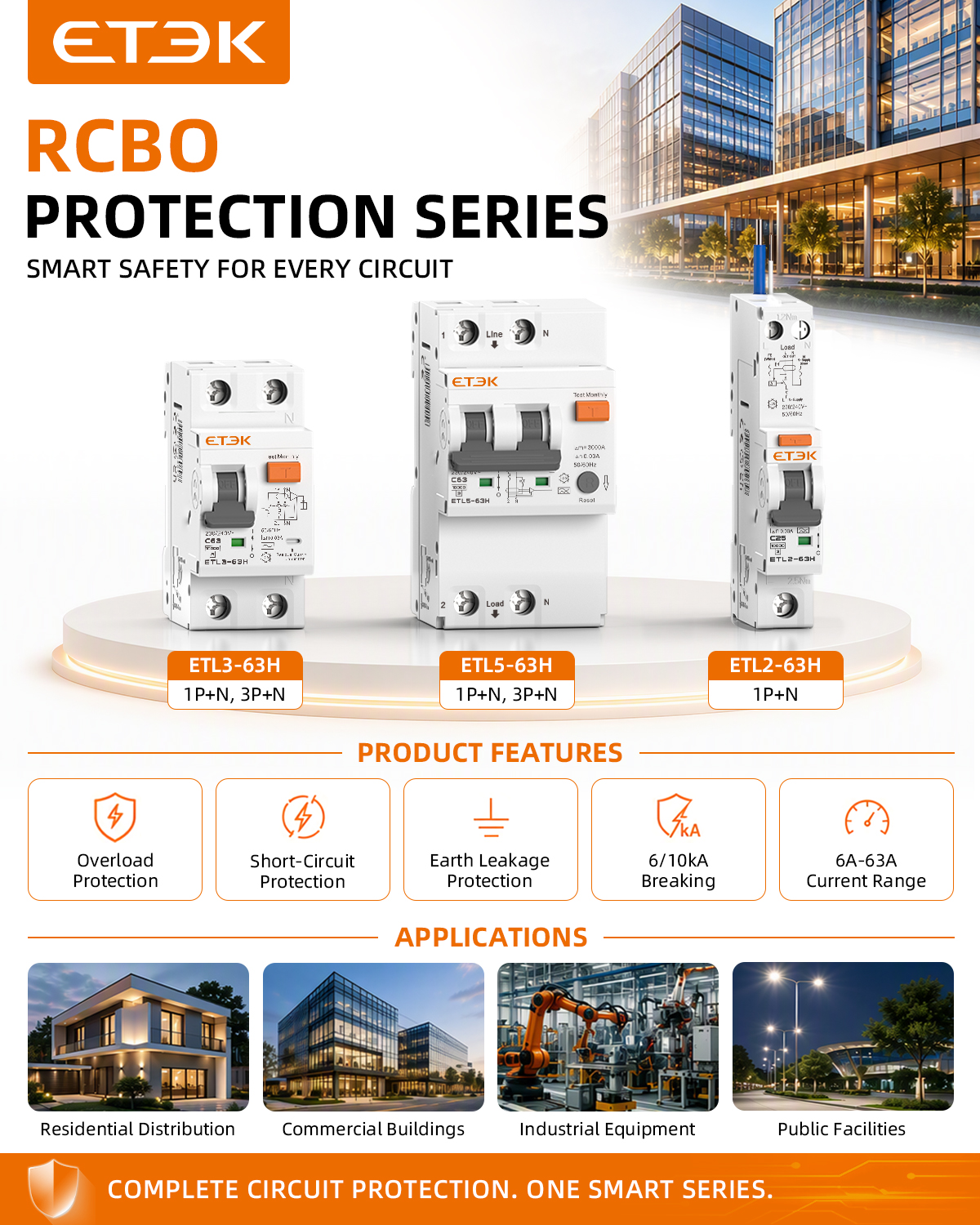
Cutting costs on breaking capacity isn't like choosing a cheaper finish. A breaker that can't handle the available fault current can fail at the exact moment it's supposed to protect the circuit—arc flash, welded contacts, or an explosion are real possibilities, not worst-case fantasies.
The issue is that fault current doesn't announce itself. Short-circuit levels depend on transformer size, cable impedance, and upstream utility changes. If you install a device rated below what the system can deliver, you're betting that a rare, high-energy event never happens. When it does, the breaker becomes the failure point rather than the safeguard.
Spending more here isn't about buying a luxury label. It's about matching the protection to the actual electrical environment. A breaker with adequate breaking capacity may cost more up front, but it prevents the kind of damage that makes the initial savings look trivial.
Type A vs AC: selecting the right RCBO for inverter-heavy sites
Inverter-heavy installations change the fault current profile in ways that catch many installers off guard. The residual current from a modern PV or drive inverter is rarely a clean 50 Hz sine wave; it often carries DC offset, high-frequency ripple, or pulsating DC components. A standard Type AC RCBO only responds to sinusoidal AC leakage, which means it can stay silent during exactly the kind of insulation failure or earth fault that an inverter is likely to produce. That silence isn't just a nuisance—it's a genuine safety gap, especially where people or livestock are involved.
Type A RCBOs are designed to trip on pulsating DC residual currents and certain superimposed DC components, making them the baseline choice for most inverter-fed circuits. But not all Type A devices behave the same under partial DC bias. Some will blind or delay if the DC level exceeds a few milliamps, which is common with transformerless PV inverters. If the site has multiple single-phase inverters or a mix of variable speed drives, you should verify the RCBO's immunity to unwanted tripping as well as its ability to detect genuine faults. A cheap Type A unit with poor DC tolerance may nuisance trip during normal inverter switching, while a better-designed one holds steady and only reacts to real leakage.
The practical selection rule is straightforward: never fit a Type AC RCBO downstream of any inverter, soft starter, or DC-link drive. For small residential PV systems and simple motor circuits, a quality Type A with a 30 mA trip rating is usually sufficient. For larger sites with high DC content or three-phase drives, consider Type A with enhanced DC immunity or a Type B if smooth DC leakage is possible. Always check the inverter manufacturer's leakage current data and the RCBO's derating curve at operating temperature—what works on a cool morning can fail on a hot afternoon when the electronics are stressed.
How to verify a wholesale batch isn't stuffed with rebranded units
Start by ripping open a few boxes and checking the physical markers that don't lie: serial number stickers with mismatched fonts, faint laser etchings under a flashlight, or molding seams that don't align with the original factory's known tooling. Rebranded units often carry over subtle scars from their first life—scratches hidden under fresh paint, or IMEI labels that peel too easily because they were reapplied. Trust the screw heads: if they show wear from a previous opening, walk away.
Next, cross-reference the batch's claimed origin story with paperwork trails that are messy in the right ways. Real wholesale lots come with inconsistencies in packing slips, handwritten corrections on export docs, or slight variations in carton weights. A too-perfect paper trail—every serial number sequential, every date stamp crisp—is a red flag. Call the original manufacturer's regional distributor and read off a few IMEIs or MAC addresses; if they come back as sold to a different region six months ago, you've found the rebrand.
Finally, test a random sample under load, not just on a bench. Rebranded electronics often fail on thermal cycling or battery health after a few hours because their internal components have been swapped for cheaper equivalents. Run a firmware update and see if the device rejects it due to a mismatched board ID. If the software version doesn't match the printed label, or the boot logo flickers with a ghost of the original brand, the batch is stuffed. You're not hunting for perfection—you're hunting for the honest mess of a genuine bulk deal.
Lead times and payment terms: negotiating without risking compliance
Negotiating lead times and payment terms often feels like a pure commercial exercise, but compliance boundaries are rarely far away. The first step is to separate what you can flex from what you cannot. A shorter lead time that requires skipping a mandated quality gate or customs check is not a win—it's a violation waiting to surface in an audit. Similarly, pushing payment terms beyond statutory limits or linking them to unofficial concessions can look like bribery or improper influence, even if that's not the intent.
A practical approach is to negotiate using objective, documented criteria. If a supplier offers faster delivery, ask what operational changes make that possible, and confirm those changes don't conflict with regulatory or contractual obligations. For payment terms, anchor your requests to market benchmarks or published deadlines, and avoid any side letters that alter the terms without a compliance review. This creates a clear audit trail and shows that speed or cash flow wasn't prioritized over legal duties.
Finally, involve compliance early but not as a blocker. A quick call before the negotiation can identify red lines—such as anti-corruption clauses, import restrictions, or prompt payment laws—so you can explore trade-offs that stay within safe territory. You might trade a longer lead time for better pricing, or offer earlier payment in exchange for a documented discount, but never as an off-the-books understanding. That keeps the deal both competitive and defensible.
The pre-delivery test report that separates pros from drop-shippers
A real pre-delivery test report is the clearest signal you're dealing with someone who actually has the machine in hand. Pros will send you a dated checklist with your unit's serial number, photos of the control panel powered on, and a short video of the spindle running through its speed range. Drop-shippers can't produce this because they never touch the inventory.
Look for specifics that can't be faked with a stock brochure: insulation resistance values, measured runout on the spindle taper, actual current draw at no load, and close-up shots of any cosmetic flaws they found before packing. If the seller hesitates or offers only a generic PDF with no serial number reference, you're almost certainly talking to a middleman who forwards orders to a third-party warehouse.
Requesting this report before payment clears isn't being difficult, it's basic due diligence. A professional treats the pre-shipment inspection as a standard step, not an optional add-on or a favor. The report doesn't just protect your purchase; it instantly filters out anyone who can't physically verify what they're selling.
FAQ
Focus on the type of residual current protection. For most residential and light commercial work, Type A RCBOs are non-negotiable because they detect pulsating DC faults from things like LED drivers, EV chargers, and inverter-driven appliances. If you only look at the price tag, you might end up with Type AC units that nuisance trip or, worse, fail to trip when needed.
Go beyond amps and poles. Check the breaking capacity — 6kA is fine for most domestic boards, but industrial panels often need 10kA. Also confirm the trip curve: B-curve for general lighting and socket circuits, C-curve for motors and HVAC. Ordering the same curve across the board can cause startup trips on compressors or welders.
Ask for batch test reports, not just the CE mark. A serious supplier will share IEC 61009 or EN 61009 compliance documents, and many will provide samples for your own bench testing. Also check how they handle warranty claims — if they make you ship faulty units back at your own cost before replacing, that's a red flag.
Yes, if you regularly work in tight consumer units or retrofit older boards. Compact RCBOs often save you from changing the whole enclosure or adding spacer din rail. But don't sacrifice cable space: check the terminal capacity. A 16mm² rising clamp terminal will make installation much faster than a tiny screw terminal.
They forget spare capacity and mixed pole requirements. If you're wiring a kitchen or workshop, you'll likely need a few 32A RCBOs for appliance circuits, but also 10A lighting and 16A general sockets. Buying a box of 10 all same rating seems cheaper, but you'll end up with dead stock. Always order per circuit schedule, plus 5-10% spares.
No, because cheap units often skimp on the neutral lead length or use a thinner copper braid. That leads to awkward busbar alignment and potential heat at the connection. Check the connection method — a rigid busbar pin or a long flexible neutral lead makes install faster and safer, even if the unit costs a few cents more.
Keep stock levels modest and reorder frequently instead of bulk buying a year's supply. Electrical standards and local amendments can shift — for example, some jurisdictions are moving toward mandatory arc fault detection on certain circuits. If you're holding hundreds of old-spec RCBOs, you might have to sell them at a loss or use them only where still permitted.
Conclusion
Buying RCBOs in bulk isn't just about chasing the lowest unit price—it's about matching the protective device to the actual site conditions without getting lost in engineering jargon. For most suppliers and contractors, obsessing over trip curve charts is less useful than knowing whether the end installation has a lot of DC leakage from inverters, heat pumps, or variable-speed drives. That's when the choice between Type A and Type AC really matters: Type AC can blind itself to smooth DC faults and fail to trip when needed, while Type A handles those inverter-heavy environments without costing a fortune. Breaking capacity is another area where penny-pinching backfires. A cheap 3kA unit might sit on a board fed by a transformer that can deliver 6kA or more under fault conditions; the result isn't a bargain, it's a fire risk and a warranty void. So the smart move is to look past the datasheet headline and ask what the supply chain actually sent you.
Beyond the technical specs, wholesale buying is a test of supply-chain judgment. A batch of brand-name RCBOs can hide rebranded or relabelled units, especially when the price seems too good or the lead time is suspiciously short. Ask for the pre-delivery test report—not just a certificate of conformity—and make sure the batch codes match the paperwork. Payment terms and lead times are negotiable, but never at the expense of compliance; a 30-day delay is cheaper than a recall. The difference between a professional supplier and a drop-shipper often comes down to whether they can produce that test report before the goods leave the warehouse, not after you've already wired them into a dozen distribution boards.
Contact Us
Contact Person: Andy
Email: [email protected]
Tel/WhatsApp: +86 13356133008
Website: https://www.etek-china.com/